



30 Jul CIVICUS Monitor: Serbia Stays on Rights Watchlist as Authorities Seek to Crush Student-led Protest Movement
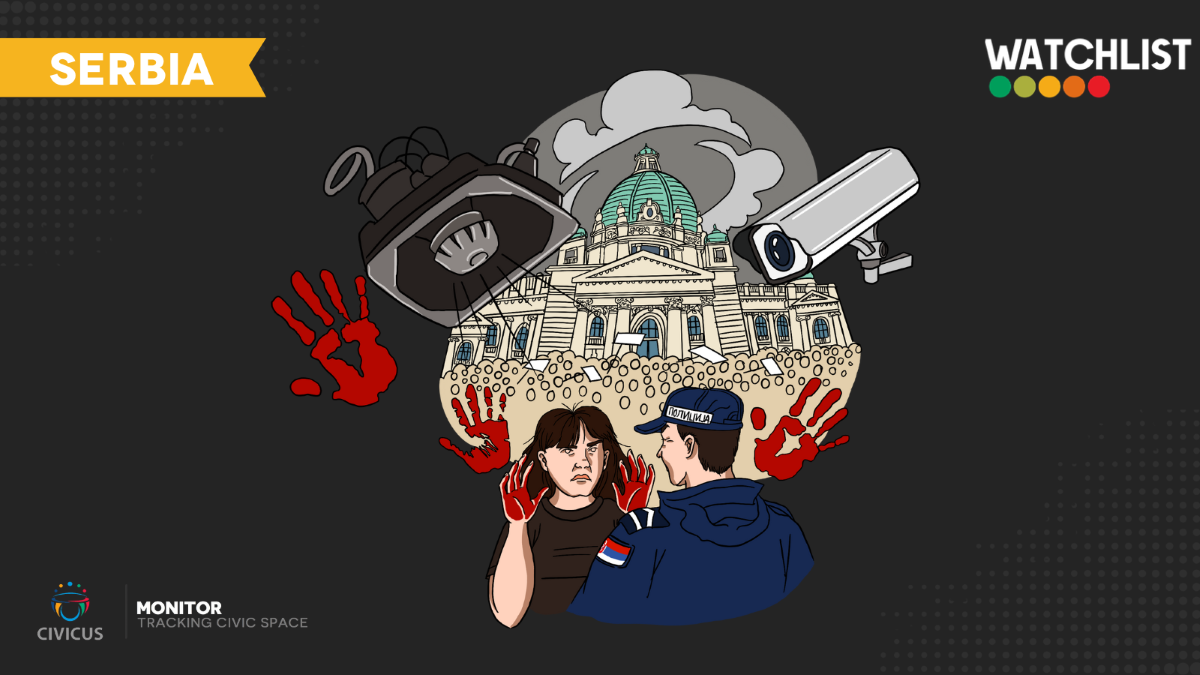
- Widespread civil disobedience met with brutality and detentions
- State providing support and legal protection to violent goons
- Alarming uptick in surveillance and intimidation of activists
Johannesburg, 30 July 2025 – The CIVICUS Monitor has once again placed Serbia on its Watchlist of countries experiencing a rapid decline in civic freedoms. The decision follows intensifying repression in response to nationwide student-led protests against government corruption, which have rocked the country since November 2024 following the deadly collapse of a railway station.
Serbia’s continued inclusion on the Watchlist reflects deepening threats to the rights to peaceful assembly, expression, and association, as authorities deploy violence, surveillance, and politically motivated prosecutions to silence dissent. CIVICUS Monitor currently rates Serbia as “obstructed”, indicating that while civil society operates, it faces serious legal and practical barriers. Serbia joins Kenya, El Salvador, Indonesia, Turkey, and the United States of America on the latest Watchlist.
“While protesters persist in their demands for accountability and systemic change, authorities are seeking to repress the movement with renewed force by unleashing a wave of state sponsored violence,” said Ine Van Severen, Civic Space Research Lead. “The Serbian government is actively punishing people who make public demands of their leaders.”
Mass Protests Met with Violence and Intimidation
To crush the student-led protests, Serbian authorities have unleashed violence from police and ruling party-linked groups, while also carrying out mass detentions, surveillance, and intimidation.
Police have repeatedly tear gassed and beat protesters, constituting excessive force, with over 400 detentions recorded in the first week of July alone. Credible reports detail serious injuries and ill-treatment in detention.
On 28 June, police violently dispersed crowds following a major protest, detaining 77 people, some of whom were denied medical assistance. In response, protesters launched acts of civil disobedience, erecting barricades and staging spontaneous demonstrations nationwide.
In March, government-organised counter-protesters established encampments around key institutions in Belgrade, backed by municipal authorities and protected by police. These camps have become flashpoints for violence, with frequent clashes and attacks on journalists.
Protesters further accuse police of unlawfully deploying a sonic weapon during a 15 March protest, attended by approximately 300,000 people. During a silent vigil, a loud, disorienting noise triggered panic and a stampede. Civil society organisations have demanded an investigation, supported by six UN special rapporteurs and an interim measure from the European Court of Human Rights.
Police initially denied involvement but later admitted that Long Range Acoustic Devices were present, while continuing to deny activation.
Senior officials have encouraged and sought to legitimise violence against protesters. In July, President Aleksandar Vučić pardoned four men linked to his party who severely beat a female student in Novi Sad—an attack that prompted the Prime Minister’s resignation in January. President Vučić also announced plans to pardon a woman charged with attempted murder for driving into a group of protesters, stating that more pardons would follow.
Officials have pressured prosecutors and judges too, accusing them of favouring protesters and undermining judicial independence. Further, state agents have intensified surveillance and criminalisation of activists ahead of major demonstrations. In March, security services illegally recorded a private meeting of opposition and civil society figures which was then broadcast on pro-government media. Police then arrested six participants of the meeting and charged them with attempting to overthrow the constitutional order, with prosecutors seeking the maximum sentence of five years, before being transferred to house arrest. Six others, now abroad, face trial in absentia.
Before a 28 June protest, more wiretapped conversations aired and authorities arrested eight student activists outside university buildings. Though a court rejected pre-trial detention, prosecutors are appealing the decision.
“The behaviour of security forces is deeply alarming. They’re protecting those who assault protesters, using violence themselves, and carrying out surveillance on activists without any legal basis or oversight,” said Uroš Jovanović, Public Policy Programme Manager at Civic Initiatives. “Violating the rights to peaceful assembly and expression does not serve the public. It only serves the interests of those who want to maintain power.”
Intimidation and Retaliation
Many protest supporters have also faced smear campaigns, job dismissals, and threats. Foreign citizens have been expelled or threatened with deportation for expressing support for protesters, while transport services have been suspended without explanation ahead of major rallies. In one case, severe police harassment of a private bus operator who had transported protesters, including fines, sabotage, threats, and the violent detention of his son, drove the operator to attempt self-immolation outside the ruling party office.
“We are watching Serbia’s civic freedoms being dismantled in real time,” said Simona Mladenovska, Policy and Advocacy Officer at the Balkan Civil Society Development Network (BCSDN). “Again, we are raising the alarm and urge the international community – especially the EU – to back words with action. We welcome the growing awareness, but the response must match the scale of repression.”
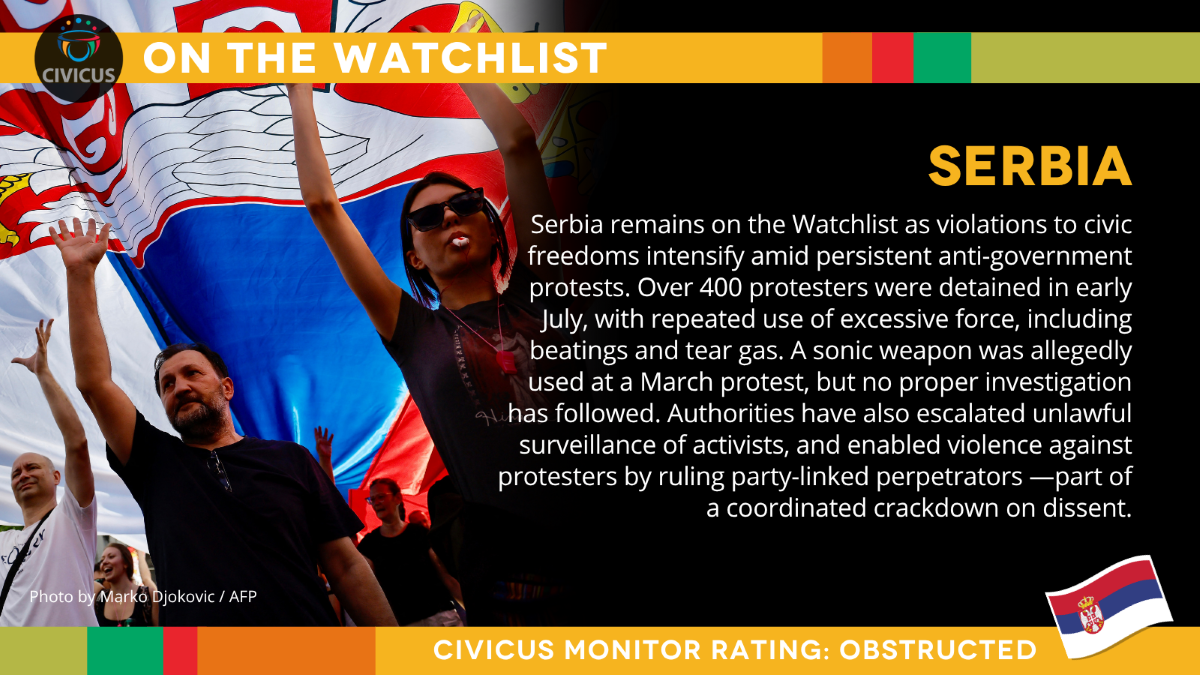
On Serbia’s civic space rating of Obstructed:
This rating is typically given to countries where civic space is heavily contested by power holders, who impose a combination of legal and practical constraints on the full enjoyment of fundamental rights (see full description of ratings). See Frequently Asked Questions about the Watchlist here.
There are a total of 35 countries in the world with this rating (see all).
About the CIVICUS Monitor::
The new watchlist is released by the CIVICUS Monitor, an online platform that tracks the latest developments to civic freedoms, including the freedoms of expression, association and peaceful assembly, across 198 countries and territories.
The ratings are categorised as either ‘closed,’ ‘repressed,’ ‘obstructed,’ ‘narrowed’ or ‘open,’ based on a methodology that combines several data sources related to civic freedoms.
Over twenty organisations collaborate to provide an evidence base for action to improve civic space on all continents.